Tuesday, April 22, 2008

Quarter Electrons May Enable Exotic Quantum Computer

QUARTER ELECTRONS crop up in new experiments that create currents of electronlike "quasiparticles" (yellow). By forcing the current through a small junction (left to right), researchers deduced that the quasiparticles had one quarter the charge of single electrons—possibly the type needed for an exotic form of quantum computer.
Genia Brodsky, Weizmann Institute of Science

A pair of new studies documents the existence of "quasiparticles" with one quarter the electric charge of a single electron—odd, considering that electrons can not actually be split into smaller particles. More than a mere curiosity, the demonstration may hold the key to a powerful form of quantum computing in which the quasiparticles' quantum states could be braided together.

Fractional charges are nothing new. Researchers learned to make them more than 20 years ago by first confining electrons to a thin layer of semiconductor, chilling them to near absolute zero (–459.67 degrees Fahrenheit, or –273.15 degrees Celsius) and applying a magnetic field. They then introduced a voltage to initiate a current that flowed around the edges of the semiconductor sample, where it encountered resistance from the material.

Strangely, the resistance grew in steps that were too small to be explained by the motions of individual electrons. Researchers believe that the fractional quantum Hall effect, as it is known, occurs because electrons merge with portions of a magnetic field into collectives that flow like individual electrons. These discoveries garnered the 1998 Nobel Prize in Physics.

The fractional quantum Hall effect seemed destined to remain an abstruse playground until 2003, when researchers discovered that certain quasiparticles could lead to a highly stable topological quantum computer. Any kind of quantum computation derives its power from turning particles into quantum bits, which represent 0 and 1 simultaneously. In conventional approaches, researchers link quantum bits using wires or lasers, which risks exposing the bits to outside vibrations that would degrade their quantum character. In contrast, certain quasiparticles could connect simply by swapping locations, much like shuffling a deck of cards. The quasiparticles would "remember" the paths they took, no matter how intertwined, which (in theory) would make them more immune to noise.

"The ideas are beautiful, and they drive very beautiful science," says experimental physicist Moty Heiblum of the Weizmann Institute of Science in Rehovot, Israel. Past examples of quasiparticles all had odd fractional charges, such as one third. For quantum computing, pairs of quasiparticles would have to join up and generate quarter charges. Inspired by the theoretical work, Heiblum's group and a team from Harvard University and the Massachusetts Institute of Technology (MIT) separately set up fractional charge experiments as usual in a layer of aluminum gallium arsenide sandwiched between layers of gallium arsenide. But they tuned the middle layer to contain five electrons for every two magnetic field lines—the state predicted to generate quarter electron charges.

The Weizmann scientists measured random fluctuations in the current across a pinch in the plane, which allows only one charge-carrying particle through at a time. This "shot noise," similar to the static in a radio signal, was consistent with quasiparticles carrying one quarter an electron charge, the group reports in Nature. The second team obtained similar results, published in Science, by measuring current directly.

Not all quarter-charge particles would work for topological quantum computation. In physics-speak, they must also obey something called non-Abelian (non-commutative) statistics, which hinges on the strength of the interaction between the paired quasiparticles. The method used by the Harvard–MIT experimenters allowed them to measure that strength. It was not conclusive, but "the favored models do indeed have non-Abelian statistics," says Harvard physicist Charles Marcus.

The observation of the new quasiparticles is "quite neat and potentially seminal," says theoretical physicist Sankar Das Sarma of the University of Maryland, College Park. The definitive test of non-Abelian statistics will come, he says, when researchers learn to isolate pairs of quasiparticles side by side and swap their positions. The Weizmann and Harvard–MIT groups are working on that, but it may take a couple of years. Heiblum predicts that of all the experiments he has done, "it will be one of the most difficult."

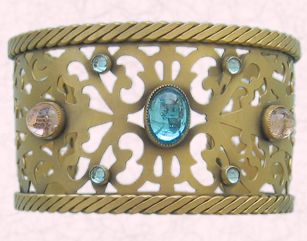
Gold Accessories Cuffs

Gold Accessories Cuffs

Gold hasn't been so popular since James Bond and Goldfinger hit the cinema screens 40 years ago!

Gold colour and shimmering metallic gold has been featured in every autumn 2006 fashion collection. Lost Horizon vintage cuff jewellery.The simplest way to add gold colour to your wardrobe is with golden jewellery or with a metallic gold tone fashion accessory. There are plenty of affordable gold fashion items around such as necklaces bangles, bags and shoes.

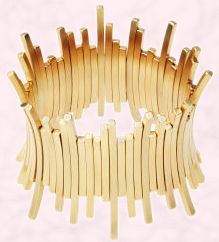
You may already have something in your jewellery box at home like this vintage YSL costume jewellery metallic gold cuff, shown left from Elaine Mintzer's real vintage website at Lost Horizon Vintage. Calow Stretch uneven edge bracelet gold cuff from John Lewis

Or a modern cuff like this Calow Stretch uneven edge bracelet gold cuff from John Lewis might be just the C21st finishing touch you need.

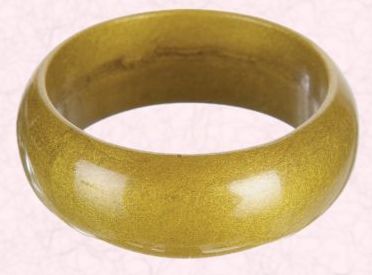
Simple gold tone bangle from Accessorize

If price is a problem, look no further than high street retailer Accessorize where later this autumn 2006, you can easily buy this simple gold tone bangle at Accessorize. Either a gold cuff or gold bangle would be good choice of golden accessory for this winter's look. The sixties feel of this gold bangle is very much in keeping with many of the modernist styles that you see in the shops.

Gold Fashion Jewellery

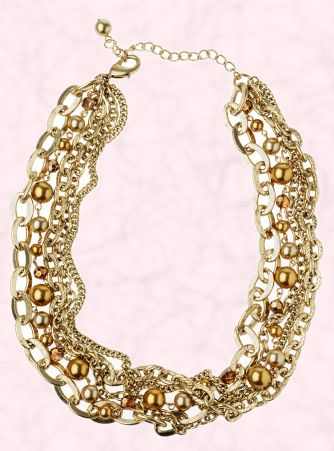
Gold Calow & pearl multi chain necklaceA gold tone chain necklace along the lines of this Calow piece from the John Lewis fashion jewellery range would make a useful gold accessory. It would give a lift to any dull workday. Equally this lovely necklace would adorn your evening outfit if you get invited unexpectedly for after work drinks.

So keep a jazz it all up necklace like this gold Calow & pearl multi chain necklace in your handbag and let fashion jewellery transform your image from day to evening.

At just £25 it won't break the bank and you can leave it in your bag all day without the real worry you might experience if it were expensive estate jewellery.

Boho necklaces have also maintained their popularity as a fashion accessory.

Gold Bags

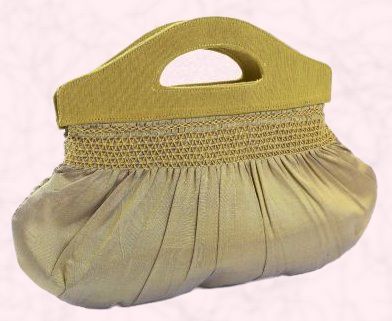
For a luxury golden fashion look you could select this lovely shimmering Makki Collection bag called Suki from The Bag Boutique.Suki from The Bag Boutique

The handbag is beautifully crafted and features a band of smocking. It's a great evening bag.

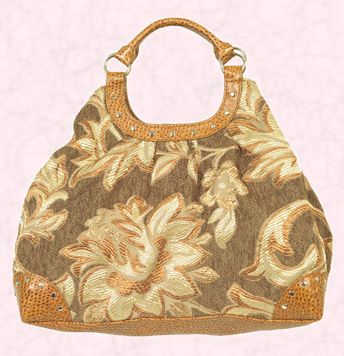
The Bag Boutique is an online retail website dedicated to providing their customers with stylish, contemporary handbags from a range of UK designers.This large roomy golden brocade bag left is from sparklingaccessories.com

If a whole garment in an opulent fabric seems too overpowering to you, look instead for a bag in gold brocade.

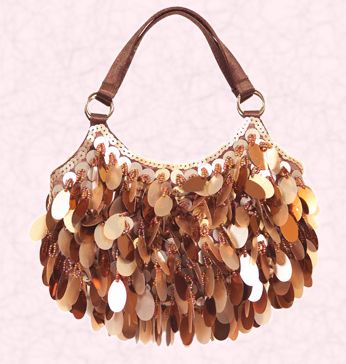
This large roomy golden brocade bag left is from sparklingaccessories.com and so is the smaller gold sequin disc evening bag below.

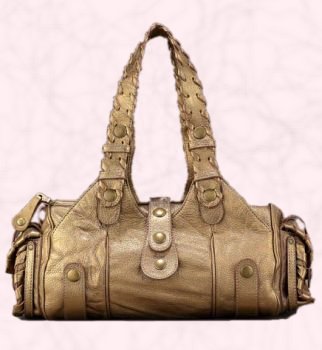
Or if you can afford it the Chloe Silverado like this metallic golden version below right is still going strong.

This large roomy sequin bag is from sparklingaccessories.com Chloe Silverado

Gold Shoes

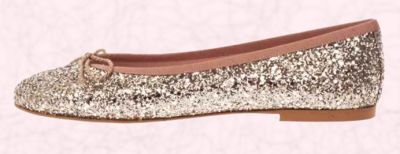
Of course the simplest way of all to become a golden lady is to add a pair of gold shoes. This autumn 2006 one of the most useful and fashionable of shoes will be the ballerina pump. Ballerina flats in all metallics including silver grey tones and animal prints are a fashion trend that is still gaining momentum.


Pretty Ballerina Flat Pump Shoes

You will find inexpensive gold ballet pumps in every high street shop selling shoes. What a practical, but great look. Ballerina flats along with newer styles of bootie shoes seem especially modern this fall. Team either type of footwear with fancy lace tights or leggings for the look of now.

With thicker tights or knee socks ballerinas can be used effectively to create the layered look. They will take you into autumn whilst your boots languish in the cupboard until a cooler day. What could be prettier than walking through autumnal leaves in your gold ballerinas.

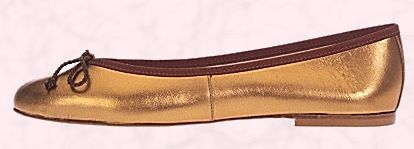
 Model 32498T-LAT a ballerina flat shoe from Prettyballerinas.comBut if you cannot get a pair easily consider ordering online from the website www.prettyballerinas.com which is based in Menorca. They have a very good selection of cute ballerina shoes in a variety of colours, styles and patterns.

Model 32498D-LAT a ballerina flat shoe from the website www.prettyballerinas.com You may like me even have your gold ballet flats already. These golden fashion ballerina shoes shown here are all images courtesy of www.prettyballerinas.com.

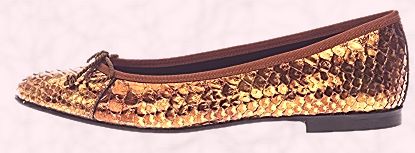
The pair called Audrey directly below are very attractive and doubly fashionable with their reptilian skin.

Audrey ballerina flat shoes from Prettyballerinas.com A ballerina flat shoe called Audrey from the website Prettyballerinas.com

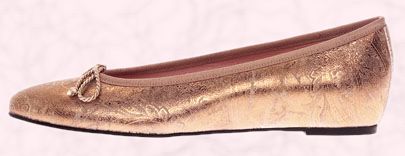
Beatrice a ballerina style of shoe in gold patterned leather from Prettyballerinas.comThis pair of pretty gold ballerinas called Beatrice are in gold patterned leather. They are interesting in that they give the illusion of being flats, but have inner elevation.

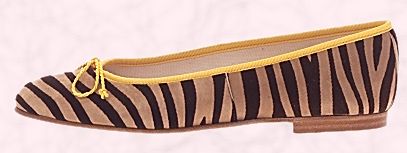
Model 3180YH-LAT a ballerina flat shoe from Prettyballerinas.comFinally this ballerina shoe combines the current fascination for animal prints with a gold trim binding. But you can see some more of these ballerina shoes on other pages here soon.

Remember versions of gold ballet pumps will carry you into next year as they are perfect with fuller skirts.

Gold Evening Shoes

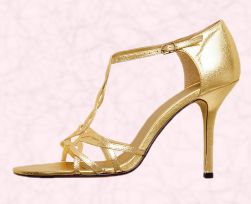
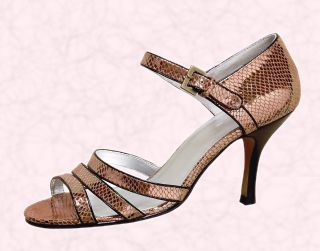
These spindly gold evening shoes below, won't break the bank and are standard stiletto heels that always have a place in the wardrobe. These gold shoes are from Matalan, are inexpensive at £14, cheap enough to wear for just one special evening. They cover the spectrum from true gold to copper gold. You could call them your Matalans!

However, if Manolos are your preference for gold shoes, then you will of course have an heirloom item, but also you need the funds to pay the price.

Gold strappy sandal by Matalan £14Snakeskin look metallic heel by Matalan £14

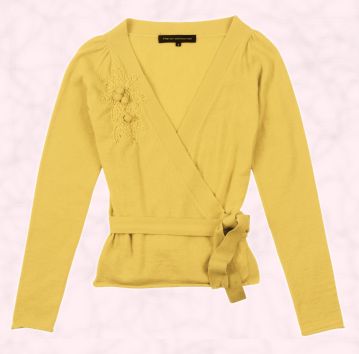
Primrose Wrap CardiganFrench Connection primrose yellow wrap cardigan at £65

A small garment like this French Connection primrose yellow wrap cardigan at £65 may be an alternative answer to a simple gold accessory. But for a wardrobe in gold see the many gorgeous gold toned dresses, jackets and coats shown on my Gold Clothes Page.

French Connection image courtesy of John Lewis.

More fashion shoes are on the shoe and boots trend pages. See main new fashion trend looks and wardrobe tips. You can read more about fall 2006/7 handbags on the accessories page and about jewellery on the jewellery page.


Wednesday, April 9, 2008

Rare blue diamond breaks world record in HK sale

[-] Text [+]

HONG KONG (Reuters) - One of the rarest gems in the world, a flawless blue diamond, has sold for US$7.98 million (3.91 million pounds) at a Sotheby's auction in Hong Kong, making it the most expensive gemstone in the world, per carat, sold at auction.

After intense bidding, the 6.04 carat, internally flawless blue diamond fetched $HK61.9 million (3.91 million pounds), or US$1.32 million per carat. The price smashed a 20-year-old record held by the "Hancock Red" -- a red diamond, which fetched US$926,000 per carat at the time, Sotheby's said.

Sotheby's said the buyer was "Moussaieff Jewellers" in London which has a reputation for acquiring extremely rare and costly gemstones. The seller was a private Asian collector.

Blue diamonds have long captivated the rich and powerful -- shimmering with a certain dark mystique. The famous "Hope Diamond", a 45.52 carat grey-blue beauty, was passed down through the ages by King Louis XIV of France, Marie Antoinette and American heiress Evalyn Walsh McClean among others. It now rests in the Smithsonian Institute in Washington D.C.

The Sultan of Brunei reportedly bought another massive "blue" which surfaced briefly in the 1980s.

While not a large stone, the Sotheby's diamond has an esteemed cut and "fancy vivid blue" hue, factors which contributed to its blockbuster price -- roughly 10 times the per-carat price of regular white diamonds.

The blue hue is a result of trace amounts of boron in the stone's crystal structure.

Other coloured diamonds with pink and red hues can be mined in multiple locations across the globe including Brazil, India and Australia, but "blues" are mostly found at just one site on earth -- the Premier Mine in South Africa.

The Hope Diamond

Hope Diamond The history of the stone which was eventually named the Hope diamond began when the French merchant traveller, Jean Baptiste Tavernier, purchased a 112 3/16-carat diamond. This diamond, which was most likely from the Kollur mine in Golconda, India, was somewhat triangular in shape and crudely cut. Its color was described by Tavernier as a "beautiful violet."

Tavernier sold the diamond to King Louis XIV of France in 1668 with 14 other large diamonds and several smaller ones. In 1673 the stone was recut by Sieur Pitau, the court jeweler, resulting in a 67 1/8-carat stone. In the royal inventories, its color was described as an intense steely-blue and the stone became known as the "Blue Diamond of the Crown," or the "French Blue." It was set in gold and suspended on a neck ribbon which the king wore on ceremonial occasions.

King Louis XV, in 1749, had the stone reset by court jeweler Andre Jacquemin, in a piece of ceremonial jewelry for the Order of the Golden Fleece (Toison D'Or). In 1791, after an attempt by Louis XVI and Marie Antoinette to flee France, the jewels of the French Royal Treasury were turned over to the government. During a week-long looting of the crown jewels in September of 1792, the French Blue diamond was stolen.

In 1812 a deep blue diamond described by John Francillion as weighing 177 grains (4 grains = 1 carat) was documented as being in the possession of London diamond merchant, Daniel Eliason. Strong evidence indicates that the stone was the recut French Blue and the same stone known today as the HopeDiamond. Several references suggest that it was acquired by King George IV of England. At his death, in 1830, the king's debts were so enormous that the blue diamond was likely sold through private channels.

The first reference to the diamond's next owner is found in the 1839 entry of the gem collection catalog of the well-known Henry Philip Hope, the man from whom the diamond takes its name. Unfortunately, the catalog does not reveal where or from whom Hope acquired the diamond or how much he paid for it.

Following the death of Henry Philip Hope in 1839, and after much litigation, the diamond passed to his nephew Henry Thomas Hope and ultimately to the nephew's grandson Lord Francis Hope. In 1901 Lord Francis Hope obtained permission from the Court of Chancery and his sisters to sell the stone to help pay off his debts. It was sold to a London dealer who quickly sold it to Joseph Frankels and Sons of New York City, who retained the stone in New York until they, in turn, needed cash. The diamond was next sold to Selim Habib who put it up for auction in Paris in 1909. It did not sell at the auction but was sold soon after to C.H. Rosenau and then resold to Pierre Cartier that same year.

In 1910 the Hope diamond was shown to Mrs. Evalyn Walsh McLean, of Washington D.C., at Cartier's in Paris, but she did not like the setting. Cartier had the diamond reset and took it to the U.S. where he left it with Mrs. McLean for a weekend. This strategy was successful. The sale was made in 1911 with the diamond mounted as a headpiece on a three-tiered circlet of large white diamonds. Sometime later it became the pendant on a diamond necklace as we know it today. Mrs. McLean's flamboyant ownership of the stone lasted until her death in 1947.

Harry Winston Inc. of New York City purchased Mrs. McLean's entire jewelry collection, including the Hope diamond, from her estate in 1949. This collection also included the 94.8-carat Star of the East diamond, the 15-carat Star of the South diamond, a 9-carat green diamond, and a 31-carat diamond which is now called the McLean diamond.

For the next 10 years the Hope diamond was shown at many exhibits and charitable events world wide by Harry Winston Inc., including as the central attraction of their Court of Jewels exhibition. On November 10, 1958, they donated the Hope diamond to the Smithsonian Institution, and almost immediately the great blue stone became its premier attraction.

The Hope diamond has left the Smithsonian only four times since it was donated. In 1962 it was exhibited for a month at the Louvre in Paris, France, as part of an exhibit entitled Ten Centuries of French Jewelry. In 1965 the Hope diamond traveled to South Africa where it was exhibited at the Rand Easter Show in Johannesburg. In 1984 the diamond was lent to Harry Winston Inc., in New York, as part of the firm's 50th anniversary celebration. In 1996 the Hope diamond was again sent to Harry Winston Inc., in New York, this time for cleaning and some minor restoration work.

The weight of the Hope diamond for many years was reported to be 44.5 carats. In 1974 it was removed from its setting and found actually to weigh 45.52 carats. It is classified as a type IIb diamond, which are semiconductive and usually phosphoresce. The Hope diamond phosphoresces a strong red color, which will last for several seconds after exposure to short wave ultra-violet light. The diamond's blue coloration is attributed to trace amounts of boron in the stone.

In the pendant surrounding the Hope diamond are 16 white diamonds, both pear-shapes and cushion cuts. A bail is soldered to the pendant where Mrs. McLean would often attach other diamonds including the McLean diamond and the Star of the East. The necklace chain contains 45 white diamonds.

photograph Mrs. Evalyn Walsh McLean wearing the Hope Diamond with the McLean Diamond (31.26 Carats) and Star of the East (94.8 Carats) attached

In December of 1988, a team from the Gemological Institute of America visited the Smithsonian to grade the great blue stone using present day techniques. They observed that the gem shows evidence of wear, has a remarkably strong phosphorescence, and that its clarity is slightly affected by a whitish graining which is common to blue diamonds. They described the color as a fancy dark grayish-blue. An examination on the same day by another gemologist using a very sensitive colorimeter revealed that there is a very slight violet component to the deep blue color which is imperceptible to the naked eye. Still, one can only wonder that the original 112 3/16-carat stone bought by Tavernier was described as "un beau violet" (a beautiful violet).

The World of Rare Stones: Painite is the World's Rarest Gem

Moussaieff Red DiamondThe world's rarest gem is believed to be painite, a gem that most have never even heard of. Rarity does not equate to beauty in gems, however. The painite is an orangish or reddish brown, with the brown tint coming from iron in the crystal. It was first discovered in Burma in the 1950s and was widely considered to be the rarest of all gems, with only two faceted crystals in existence. Within the last couple of years, however, the source of the original painite crystals was discovered, and now a few hundred faceted stones exist.

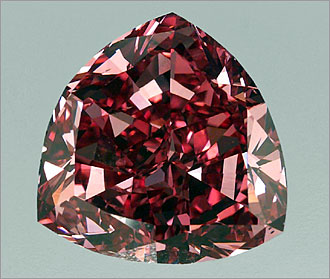
A more widely recognized (but still very rare) gem is the red diamond. There are many more red diamonds available than some other rare gems, but very large red diamonds are extremely rare. The largest cut natural red diamond may be the one owned by Moussaieff Jewellers Ltd, a 5.11 carat trillion cut.

The rare blue diamond, made famous by the Hope Diamond, gets its deep blue color from traces of boron in the stone. It is a natural blue diamond, in contrast with most of today's blue diamonds, which are turned from clear to blue with a process involving irradiation and heat.

The Hope Diamond was believed to be originally over 112 carats, but was poorly cut. It was recut in the 1600's, resulting in a stone just over 67 carats. It changed hands many times, and got its name from Henry Philip Hope, who acquired the diamond in 1839. After it changed hands a few more times, the Hope Diamond came to rest in the care of the Smithsonian, and now weighs over 45 carats.

Saturday, March 29, 2008

News Bytes of the Week--Smoldering Hawaiian volcano an ongoing geologic hottie


Hawaii's Kilauea Volcano ranks among the world's most active volcanoes and may even top the list.
Courtesy of the U.S. Geological Survey, J. Kauahikaua

Hawaiian volcano letting off steam (not to mention sulfur dioxide and lava)
Kilauea Volcano on Hawaii's largest island piped up with explosive eruptions and toxic sulfur dioxide emissions, the latest sign of unrest in the crater's turbulent history. Now U.S. Geological Survey (USGS) scientists are scrambling to predict the volcano's next move and whether neighboring villagers are in harm's way. Also, the National Park Service has closed indefinitely Crater Rim Drive, which runs through the south caldera area. Kilauea has been the site of 34 eruptions since 1952, and eruptive activity has been continuous along its east rift zone since January 1983. All told, Kilauea ranks among the world's most active volcanoes and may even top the list, scientists say. As of Monday, the volcano was active both at its summit (where the Halema`uma`u vent has been spewing hot ash, steam and gas, elevating sulfur dioxide emission rates and seismic tremor levels) and at the coast (where lava continued to flow into the ocean), according to the USGS Hawaiian Volcano Observatory. The volcano is also the site of a national park, although sightseers might want to keep their distance until Kilauea cools off.

The clockwork employee? Biometric punch clock scans body parts
"Punching the clock" will soon take on new meaning as companies adopt biometric devices that check palm- and fingerprints to keep tabs on their employees. Business execs say that biometrics (a group of technologies that scan and store information about body parts unique to each person—including fingers, palms or eyes) help them more precisely log the comings and goings of workers, and that this information can automatically be sent to payroll systems to streamline that process. New York City–based technology consulting firm International Biometric Group, LLC, estimates that biometric device sales last year totaled $635 million, and projects revenues will exceed $1 billion by 2011, according to the Associated Press, which also reports that the Dunkin' Donuts and McDonald's franchises as well as Hilton Hotels and the U.S. Marine Corps have purchased biometrics from manufacturer Ingersoll–Rand Security Technologies. In New York City, the Office of Payroll Administration has a $181.1-million contract through 2009 with the Science Applications International Corporation to install a biometric timekeeping system called CityTime, The New York Times reports. City officials say the new system will save taxpayers $60 million annually by modernizing its existing record-keeping system (which required a full-time timekeeper for every 100 to 250 employees). But not everyone's on board. Critics say the technology is intrusive and an invasion of privacy, not to mention a potential purveyor of germs, because so many people will stick their germ-coated fingers or palms in them.

Move over, Edison, historians uncover oldest voice recording—and it's not yours
Until today, most of the free world believed Thomas Alva Edison was the first person to make a sound recording when he developed the phonograph in 1877 and created an audible archive of himself reciting "Mary had a little lamb" on a sheet of tinfoil. But, it turns out that a Frenchman beat him to the chase. The New York Times reports that scientists at Lawrence Berkeley National Laboratory in California recently discovered that a piece of paper coated with oil lamp smoke, which dated back to 1860 and for years had been in a Paris archive, actually had a 10-second recording etched into it. When the researchers converted the etchings into sound with optical-imaging technology, they heard a female voice crooning a French folk song. Maryland-based audio historian David Giovannoni tracked down and unveiled the recording—made by French inventor Édouard-Léon Scott de Martinville. Giovannoni said today at Stanford University that the inventor was probably trying to render a visual representation of sound by creating a device called a phonautogram. The machine, which could document sound to create a paper record but did not have playback capabilities, consisted of a barrel-like recording horn connected to a stylus (like that on a phonograph or record player). It would take Edison's invention 17 years later to play back recorded sound. (The New York Times, Reuters)


Something to sniff at: You can smell danger
Apparently your nose can do more than guide you toward a fresh pie cooling on a windowsill. It can also be trained to sense danger. Researchers at Northwestern University's Feinberg School of Medicine in Chicago report in Science that 12 volunteers had trouble discerning between two "grassy" scents—until, that is, they were subjected to a mild electric shock after sniffing at one of them. Once jolted, the subjects easily differentiated between the aromas, illustrating, the scientists say, our evolutionary ability to pick up cues important to survival from a flood of sensory information. They note that scans of the volunteers before and after the experiment showed clear alterations in their brains' olfactory centers. (BBC, Chicago Tribune)

Silicon circuits take a stretch
Don't get bent out of shape over new research that shows how to stretch, bend and fold integrated silicon circuits. Materials scientists from the University of Illinois at Urbana–Champaign report in Science that they sandwiched thin ribbons of silicon between taut pieces of rubber-like plastic that were then allowed to snap back to their original size, causing the silicon to crumple [see video below]. Because of the newfound slack in the silicon strips, the plastic circuits could stretch and twist while still carrying electricity, the group says. If researchers can stretch the technology to its logical limit, they might be able to stuff computers into everything from silk shirts to surgical gloves. (Science)


Feds Agree to Toxicity Tests That Cut Animal Testing


ANIMAL'S BEST FRIEND: Government scientists want to make better use of robotic equipment to conduct in vitro testing of human cells and cellular components to identify chemicals with toxic effects and cut back on their use of lab animals.
Courtesy of NIH's National Human Genome Research Institute

Rodents and primates around the world can breathe a little easier. Ditto animal rights activists who have long opposed testing drugs and conducting other experiments on animals. Top officials from the U.S. National Institutes of Health (NIH) and Environmental Protection Agency (EPA) Thursday announced a five-year deal promising to share technology, information and other resources that will improve the toxicity testing of chemical compounds used in food, medicine and other products using robots rather than lab animals.

This joint effort will include experts from the NIH National Toxicology Program (NTP), high-speed, automated screening robots at the NIH Chemical Genomics Center and computational toxicology capabilities available at the EPA Office of Research and Development's National Center for Computational Toxicology (NCCT).

"Today we want to report to you this remarkable collaboration," Elias Zerhouni, director of the NIH, said during a teleconference with reporters held to announce the groundbreaking agreement. He added that the effort—designed to expand the use of in vitro testing of human cells and cellular components to identify chemicals with toxic effects—represents the "birth of a new approach to a crucial problem in public health."

The agencies are hoping to coordinate their resources to better identify toxicity pathways, select chemicals for testing, analyze and interpret data, and promote their findings to scientific and regulatory communities. This is expected to generate data more relevant to humans, expand the number of chemicals tested and reduce the time, money and number of animals involved in current lab studies. The collective budget is yet to be determined, the agencies say.

Animal testing has always been a sore point for scientists and animal-rights advocates, following some high-profile cases of mistreatment of lab animals, such as monkeys discovered in 1981 at the Institute for Behavioral Research in Silver Spring, Md., in deplorable conditions. One of the primary ways to test the toxicology of a compound has been to inject it into a lab animal, see if the animal gets sick, and then conduct an autopsy to observe the damage done to their internal organs. (For more on this, click here. Additional information on animal rights legislation can be found here.)

Scientists present at the news conference agreed that animal testing has yielded some important medical breakthroughs. But Robert Kavlock, director of the NCCT, said that it also is expensive, inefficient and is not always an accurate indicator of how a substance will affect humans.

"The desire here is to see if we could do better," said Francis Collins, director of the NIH's National Human Genome Research Institute. He said the federal government is exploring the feasibility of using high-throughput assays to allow scientists to "look at toxicology in a totally new way."

"The news here is the capacity to test many thousands of compounds, something we haven't had until this collaboration," Samuel Wilson, acting director of the NIH National Institute of Environmental Health Sciences and NTP, said at the press conference. The new research model would allow scientists to test 100,000 compounds in 1,500 different concentrations in about two days compared with years if the testing was done on animals. This sort of "high-throughput" testing will enable researchers to generate more data relevant to humans, and at the same time reduce the amount of animal experimentation. The cross-species extrapolation from animals to humans is "not always as precise as it should be," Wilson said. "This collaboration is a milestone because it gives us the ability to apply a new generation of approaches to determining toxicities."

The scientists were unable to provide a specific time frame for when the technology might produce significant results or predict how many fewer animals would be used in testing if their effort is a success. They stressed that they plan to move quickly to test the new technology and reduce animal testing as soon and as much as possible.

But they acknowledged that some animal testing will continue at least until the technology proves its mettle in large-scale studies or until Congress passes a substance regulation act similar to the European Union's (E.U.) Registration, Evaluation, Authorization and Restriction of Chemicals, or (REACH), which regulates chemicals and their safe use. It is set to take effect in March 2009 and bans such testing.

The officials noted that despite the E.U.'s pending ban, it is unclear whether scientists in Europe have access alternative methods of toxicology testing. Wilson noted that the technology being tested by the EPA and NIH is not yet available in the E.U.

For now, NIH chief Zerhouni said, animal testing will continue in the U.S. in conjunction with the new high-speed, automated screening technology. There are several other approaches under development that would also allow relatively quick, inexpensive testing of a large number of compounds and cells simultaneously. "We plan to use all of these," Christopher Austin, director of the NIH's Chemical Genomics Center, said at the news conference.

As ScientificAmerican.com reported in December, researchers at Rensselaer Polytechnic Institute in Troy, N.Y., the University of California, Berkeley, and Solidus Biosciences, Inc. (a biotech company located at the Rensselaer Incubator Program for start-up businesses) have developed biochips—called MetaChip and DataChip—that mimic what the body does when it ingests a drug. MetaChip is actually a glass slide dotted with 20-nanoliter droplets—each 20 billionths of a liter—of a solution containing human liver enzymes; DataChip is a slide lined with droplets containing cell cultures from the bladder, kidney or liver. Scientists can test the safety of a chemical by putting drops of it onto these slides and measuring the culture's growth or shrinkage over time.

These biochips are used with a high-throughput microarray spotter machine that places the liquid enzyme dots on the slides. The next step involves an optical assay system consisting of a camera connected to a fluorescent light source to take a digital image of the cell culture and highlight living and dead cells. Austin noted, however, that MetaChip and DataChip are not currently capable of handling the volume of testing that the government wants to conduct.