Tuesday, April 22, 2008

Quarter Electrons May Enable Exotic Quantum Computer

QUARTER ELECTRONS crop up in new experiments that create currents of electronlike "quasiparticles" (yellow). By forcing the current through a small junction (left to right), researchers deduced that the quasiparticles had one quarter the charge of single electrons—possibly the type needed for an exotic form of quantum computer.
Genia Brodsky, Weizmann Institute of Science

A pair of new studies documents the existence of "quasiparticles" with one quarter the electric charge of a single electron—odd, considering that electrons can not actually be split into smaller particles. More than a mere curiosity, the demonstration may hold the key to a powerful form of quantum computing in which the quasiparticles' quantum states could be braided together.

Fractional charges are nothing new. Researchers learned to make them more than 20 years ago by first confining electrons to a thin layer of semiconductor, chilling them to near absolute zero (–459.67 degrees Fahrenheit, or –273.15 degrees Celsius) and applying a magnetic field. They then introduced a voltage to initiate a current that flowed around the edges of the semiconductor sample, where it encountered resistance from the material.

Strangely, the resistance grew in steps that were too small to be explained by the motions of individual electrons. Researchers believe that the fractional quantum Hall effect, as it is known, occurs because electrons merge with portions of a magnetic field into collectives that flow like individual electrons. These discoveries garnered the 1998 Nobel Prize in Physics.

The fractional quantum Hall effect seemed destined to remain an abstruse playground until 2003, when researchers discovered that certain quasiparticles could lead to a highly stable topological quantum computer. Any kind of quantum computation derives its power from turning particles into quantum bits, which represent 0 and 1 simultaneously. In conventional approaches, researchers link quantum bits using wires or lasers, which risks exposing the bits to outside vibrations that would degrade their quantum character. In contrast, certain quasiparticles could connect simply by swapping locations, much like shuffling a deck of cards. The quasiparticles would "remember" the paths they took, no matter how intertwined, which (in theory) would make them more immune to noise.

"The ideas are beautiful, and they drive very beautiful science," says experimental physicist Moty Heiblum of the Weizmann Institute of Science in Rehovot, Israel. Past examples of quasiparticles all had odd fractional charges, such as one third. For quantum computing, pairs of quasiparticles would have to join up and generate quarter charges. Inspired by the theoretical work, Heiblum's group and a team from Harvard University and the Massachusetts Institute of Technology (MIT) separately set up fractional charge experiments as usual in a layer of aluminum gallium arsenide sandwiched between layers of gallium arsenide. But they tuned the middle layer to contain five electrons for every two magnetic field lines—the state predicted to generate quarter electron charges.

The Weizmann scientists measured random fluctuations in the current across a pinch in the plane, which allows only one charge-carrying particle through at a time. This "shot noise," similar to the static in a radio signal, was consistent with quasiparticles carrying one quarter an electron charge, the group reports in Nature. The second team obtained similar results, published in Science, by measuring current directly.

Not all quarter-charge particles would work for topological quantum computation. In physics-speak, they must also obey something called non-Abelian (non-commutative) statistics, which hinges on the strength of the interaction between the paired quasiparticles. The method used by the Harvard–MIT experimenters allowed them to measure that strength. It was not conclusive, but "the favored models do indeed have non-Abelian statistics," says Harvard physicist Charles Marcus.

The observation of the new quasiparticles is "quite neat and potentially seminal," says theoretical physicist Sankar Das Sarma of the University of Maryland, College Park. The definitive test of non-Abelian statistics will come, he says, when researchers learn to isolate pairs of quasiparticles side by side and swap their positions. The Weizmann and Harvard–MIT groups are working on that, but it may take a couple of years. Heiblum predicts that of all the experiments he has done, "it will be one of the most difficult."

Gold Accessories Cuffs

Gold Accessories Cuffs

Gold hasn't been so popular since James Bond and Goldfinger hit the cinema screens 40 years ago!

Gold colour and shimmering metallic gold has been featured in every autumn 2006 fashion collection. Lost Horizon vintage cuff jewellery.The simplest way to add gold colour to your wardrobe is with golden jewellery or with a metallic gold tone fashion accessory. There are plenty of affordable gold fashion items around such as necklaces bangles, bags and shoes.

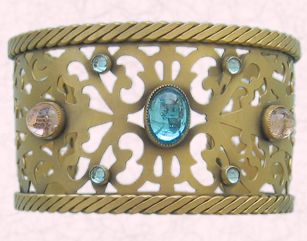
You may already have something in your jewellery box at home like this vintage YSL costume jewellery metallic gold cuff, shown left from Elaine Mintzer's real vintage website at Lost Horizon Vintage. Calow Stretch uneven edge bracelet gold cuff from John Lewis

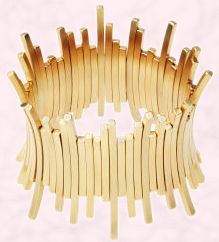
Or a modern cuff like this Calow Stretch uneven edge bracelet gold cuff from John Lewis might be just the C21st finishing touch you need.

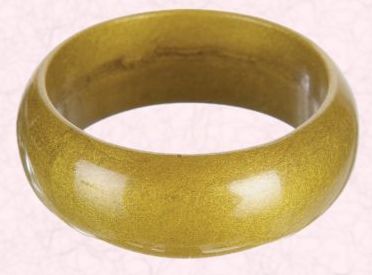
Simple gold tone bangle from Accessorize

If price is a problem, look no further than high street retailer Accessorize where later this autumn 2006, you can easily buy this simple gold tone bangle at Accessorize. Either a gold cuff or gold bangle would be good choice of golden accessory for this winter's look. The sixties feel of this gold bangle is very much in keeping with many of the modernist styles that you see in the shops.

Gold Fashion Jewellery

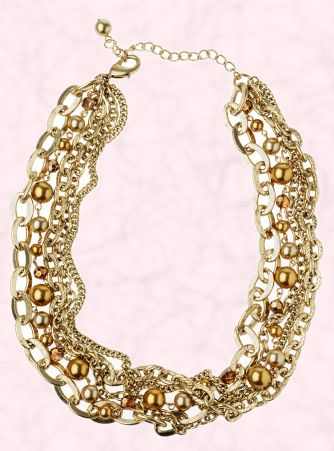
Gold Calow & pearl multi chain necklaceA gold tone chain necklace along the lines of this Calow piece from the John Lewis fashion jewellery range would make a useful gold accessory. It would give a lift to any dull workday. Equally this lovely necklace would adorn your evening outfit if you get invited unexpectedly for after work drinks.

So keep a jazz it all up necklace like this gold Calow & pearl multi chain necklace in your handbag and let fashion jewellery transform your image from day to evening.

At just £25 it won't break the bank and you can leave it in your bag all day without the real worry you might experience if it were expensive estate jewellery.

Boho necklaces have also maintained their popularity as a fashion accessory.

Gold Bags

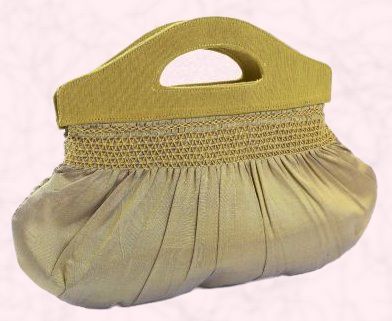
For a luxury golden fashion look you could select this lovely shimmering Makki Collection bag called Suki from The Bag Boutique.Suki from The Bag Boutique

The handbag is beautifully crafted and features a band of smocking. It's a great evening bag.

The Bag Boutique is an online retail website dedicated to providing their customers with stylish, contemporary handbags from a range of UK designers.This large roomy golden brocade bag left is from sparklingaccessories.com

If a whole garment in an opulent fabric seems too overpowering to you, look instead for a bag in gold brocade.

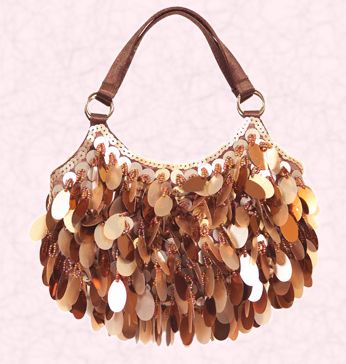
This large roomy golden brocade bag left is from sparklingaccessories.com and so is the smaller gold sequin disc evening bag below.

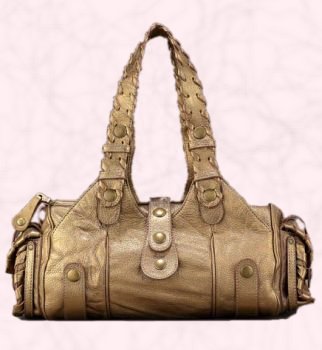
Or if you can afford it the Chloe Silverado like this metallic golden version below right is still going strong.

This large roomy sequin bag is from sparklingaccessories.com Chloe Silverado

Gold Shoes

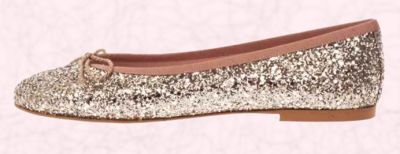
Of course the simplest way of all to become a golden lady is to add a pair of gold shoes. This autumn 2006 one of the most useful and fashionable of shoes will be the ballerina pump. Ballerina flats in all metallics including silver grey tones and animal prints are a fashion trend that is still gaining momentum.


Pretty Ballerina Flat Pump Shoes

You will find inexpensive gold ballet pumps in every high street shop selling shoes. What a practical, but great look. Ballerina flats along with newer styles of bootie shoes seem especially modern this fall. Team either type of footwear with fancy lace tights or leggings for the look of now.

With thicker tights or knee socks ballerinas can be used effectively to create the layered look. They will take you into autumn whilst your boots languish in the cupboard until a cooler day. What could be prettier than walking through autumnal leaves in your gold ballerinas.

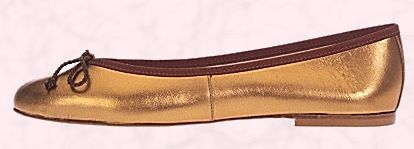
 Model 32498T-LAT a ballerina flat shoe from Prettyballerinas.comBut if you cannot get a pair easily consider ordering online from the website www.prettyballerinas.com which is based in Menorca. They have a very good selection of cute ballerina shoes in a variety of colours, styles and patterns.

Model 32498D-LAT a ballerina flat shoe from the website www.prettyballerinas.com You may like me even have your gold ballet flats already. These golden fashion ballerina shoes shown here are all images courtesy of www.prettyballerinas.com.

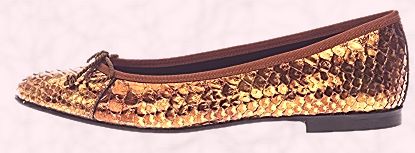
The pair called Audrey directly below are very attractive and doubly fashionable with their reptilian skin.

Audrey ballerina flat shoes from Prettyballerinas.com A ballerina flat shoe called Audrey from the website Prettyballerinas.com

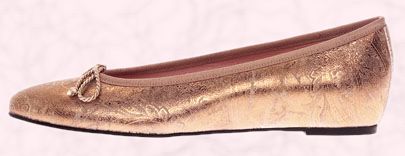
Beatrice a ballerina style of shoe in gold patterned leather from Prettyballerinas.comThis pair of pretty gold ballerinas called Beatrice are in gold patterned leather. They are interesting in that they give the illusion of being flats, but have inner elevation.

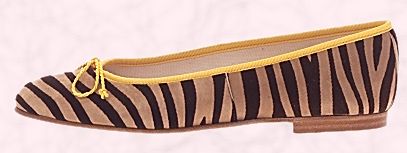
Model 3180YH-LAT a ballerina flat shoe from Prettyballerinas.comFinally this ballerina shoe combines the current fascination for animal prints with a gold trim binding. But you can see some more of these ballerina shoes on other pages here soon.

Remember versions of gold ballet pumps will carry you into next year as they are perfect with fuller skirts.

Gold Evening Shoes

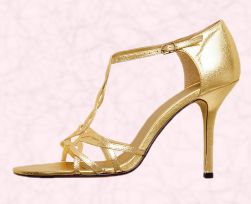
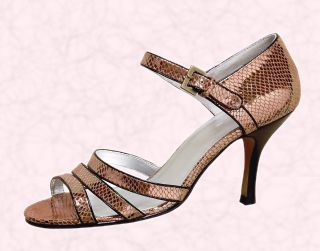
These spindly gold evening shoes below, won't break the bank and are standard stiletto heels that always have a place in the wardrobe. These gold shoes are from Matalan, are inexpensive at £14, cheap enough to wear for just one special evening. They cover the spectrum from true gold to copper gold. You could call them your Matalans!

However, if Manolos are your preference for gold shoes, then you will of course have an heirloom item, but also you need the funds to pay the price.

Gold strappy sandal by Matalan £14Snakeskin look metallic heel by Matalan £14

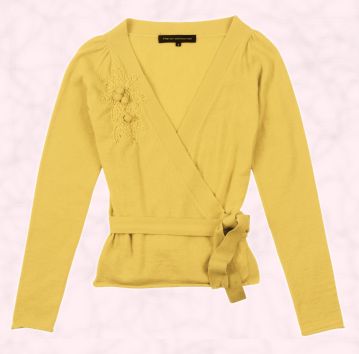
Primrose Wrap CardiganFrench Connection primrose yellow wrap cardigan at £65

A small garment like this French Connection primrose yellow wrap cardigan at £65 may be an alternative answer to a simple gold accessory. But for a wardrobe in gold see the many gorgeous gold toned dresses, jackets and coats shown on my Gold Clothes Page.

French Connection image courtesy of John Lewis.

More fashion shoes are on the shoe and boots trend pages. See main new fashion trend looks and wardrobe tips. You can read more about fall 2006/7 handbags on the accessories page and about jewellery on the jewellery page.


Wednesday, April 9, 2008

Rare blue diamond breaks world record in HK sale

[-] Text [+]

HONG KONG (Reuters) - One of the rarest gems in the world, a flawless blue diamond, has sold for US$7.98 million (3.91 million pounds) at a Sotheby's auction in Hong Kong, making it the most expensive gemstone in the world, per carat, sold at auction.

After intense bidding, the 6.04 carat, internally flawless blue diamond fetched $HK61.9 million (3.91 million pounds), or US$1.32 million per carat. The price smashed a 20-year-old record held by the "Hancock Red" -- a red diamond, which fetched US$926,000 per carat at the time, Sotheby's said.

Sotheby's said the buyer was "Moussaieff Jewellers" in London which has a reputation for acquiring extremely rare and costly gemstones. The seller was a private Asian collector.

Blue diamonds have long captivated the rich and powerful -- shimmering with a certain dark mystique. The famous "Hope Diamond", a 45.52 carat grey-blue beauty, was passed down through the ages by King Louis XIV of France, Marie Antoinette and American heiress Evalyn Walsh McClean among others. It now rests in the Smithsonian Institute in Washington D.C.

The Sultan of Brunei reportedly bought another massive "blue" which surfaced briefly in the 1980s.

While not a large stone, the Sotheby's diamond has an esteemed cut and "fancy vivid blue" hue, factors which contributed to its blockbuster price -- roughly 10 times the per-carat price of regular white diamonds.

The blue hue is a result of trace amounts of boron in the stone's crystal structure.

Other coloured diamonds with pink and red hues can be mined in multiple locations across the globe including Brazil, India and Australia, but "blues" are mostly found at just one site on earth -- the Premier Mine in South Africa.

The Hope Diamond

Hope Diamond The history of the stone which was eventually named the Hope diamond began when the French merchant traveller, Jean Baptiste Tavernier, purchased a 112 3/16-carat diamond. This diamond, which was most likely from the Kollur mine in Golconda, India, was somewhat triangular in shape and crudely cut. Its color was described by Tavernier as a "beautiful violet."

Tavernier sold the diamond to King Louis XIV of France in 1668 with 14 other large diamonds and several smaller ones. In 1673 the stone was recut by Sieur Pitau, the court jeweler, resulting in a 67 1/8-carat stone. In the royal inventories, its color was described as an intense steely-blue and the stone became known as the "Blue Diamond of the Crown," or the "French Blue." It was set in gold and suspended on a neck ribbon which the king wore on ceremonial occasions.

King Louis XV, in 1749, had the stone reset by court jeweler Andre Jacquemin, in a piece of ceremonial jewelry for the Order of the Golden Fleece (Toison D'Or). In 1791, after an attempt by Louis XVI and Marie Antoinette to flee France, the jewels of the French Royal Treasury were turned over to the government. During a week-long looting of the crown jewels in September of 1792, the French Blue diamond was stolen.

In 1812 a deep blue diamond described by John Francillion as weighing 177 grains (4 grains = 1 carat) was documented as being in the possession of London diamond merchant, Daniel Eliason. Strong evidence indicates that the stone was the recut French Blue and the same stone known today as the HopeDiamond. Several references suggest that it was acquired by King George IV of England. At his death, in 1830, the king's debts were so enormous that the blue diamond was likely sold through private channels.

The first reference to the diamond's next owner is found in the 1839 entry of the gem collection catalog of the well-known Henry Philip Hope, the man from whom the diamond takes its name. Unfortunately, the catalog does not reveal where or from whom Hope acquired the diamond or how much he paid for it.

Following the death of Henry Philip Hope in 1839, and after much litigation, the diamond passed to his nephew Henry Thomas Hope and ultimately to the nephew's grandson Lord Francis Hope. In 1901 Lord Francis Hope obtained permission from the Court of Chancery and his sisters to sell the stone to help pay off his debts. It was sold to a London dealer who quickly sold it to Joseph Frankels and Sons of New York City, who retained the stone in New York until they, in turn, needed cash. The diamond was next sold to Selim Habib who put it up for auction in Paris in 1909. It did not sell at the auction but was sold soon after to C.H. Rosenau and then resold to Pierre Cartier that same year.

In 1910 the Hope diamond was shown to Mrs. Evalyn Walsh McLean, of Washington D.C., at Cartier's in Paris, but she did not like the setting. Cartier had the diamond reset and took it to the U.S. where he left it with Mrs. McLean for a weekend. This strategy was successful. The sale was made in 1911 with the diamond mounted as a headpiece on a three-tiered circlet of large white diamonds. Sometime later it became the pendant on a diamond necklace as we know it today. Mrs. McLean's flamboyant ownership of the stone lasted until her death in 1947.

Harry Winston Inc. of New York City purchased Mrs. McLean's entire jewelry collection, including the Hope diamond, from her estate in 1949. This collection also included the 94.8-carat Star of the East diamond, the 15-carat Star of the South diamond, a 9-carat green diamond, and a 31-carat diamond which is now called the McLean diamond.

For the next 10 years the Hope diamond was shown at many exhibits and charitable events world wide by Harry Winston Inc., including as the central attraction of their Court of Jewels exhibition. On November 10, 1958, they donated the Hope diamond to the Smithsonian Institution, and almost immediately the great blue stone became its premier attraction.

The Hope diamond has left the Smithsonian only four times since it was donated. In 1962 it was exhibited for a month at the Louvre in Paris, France, as part of an exhibit entitled Ten Centuries of French Jewelry. In 1965 the Hope diamond traveled to South Africa where it was exhibited at the Rand Easter Show in Johannesburg. In 1984 the diamond was lent to Harry Winston Inc., in New York, as part of the firm's 50th anniversary celebration. In 1996 the Hope diamond was again sent to Harry Winston Inc., in New York, this time for cleaning and some minor restoration work.

The weight of the Hope diamond for many years was reported to be 44.5 carats. In 1974 it was removed from its setting and found actually to weigh 45.52 carats. It is classified as a type IIb diamond, which are semiconductive and usually phosphoresce. The Hope diamond phosphoresces a strong red color, which will last for several seconds after exposure to short wave ultra-violet light. The diamond's blue coloration is attributed to trace amounts of boron in the stone.

In the pendant surrounding the Hope diamond are 16 white diamonds, both pear-shapes and cushion cuts. A bail is soldered to the pendant where Mrs. McLean would often attach other diamonds including the McLean diamond and the Star of the East. The necklace chain contains 45 white diamonds.

photograph Mrs. Evalyn Walsh McLean wearing the Hope Diamond with the McLean Diamond (31.26 Carats) and Star of the East (94.8 Carats) attached

In December of 1988, a team from the Gemological Institute of America visited the Smithsonian to grade the great blue stone using present day techniques. They observed that the gem shows evidence of wear, has a remarkably strong phosphorescence, and that its clarity is slightly affected by a whitish graining which is common to blue diamonds. They described the color as a fancy dark grayish-blue. An examination on the same day by another gemologist using a very sensitive colorimeter revealed that there is a very slight violet component to the deep blue color which is imperceptible to the naked eye. Still, one can only wonder that the original 112 3/16-carat stone bought by Tavernier was described as "un beau violet" (a beautiful violet).

The World of Rare Stones: Painite is the World's Rarest Gem

Moussaieff Red DiamondThe world's rarest gem is believed to be painite, a gem that most have never even heard of. Rarity does not equate to beauty in gems, however. The painite is an orangish or reddish brown, with the brown tint coming from iron in the crystal. It was first discovered in Burma in the 1950s and was widely considered to be the rarest of all gems, with only two faceted crystals in existence. Within the last couple of years, however, the source of the original painite crystals was discovered, and now a few hundred faceted stones exist.

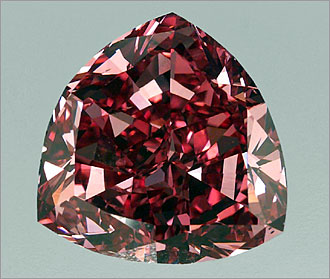
A more widely recognized (but still very rare) gem is the red diamond. There are many more red diamonds available than some other rare gems, but very large red diamonds are extremely rare. The largest cut natural red diamond may be the one owned by Moussaieff Jewellers Ltd, a 5.11 carat trillion cut.

The rare blue diamond, made famous by the Hope Diamond, gets its deep blue color from traces of boron in the stone. It is a natural blue diamond, in contrast with most of today's blue diamonds, which are turned from clear to blue with a process involving irradiation and heat.

The Hope Diamond was believed to be originally over 112 carats, but was poorly cut. It was recut in the 1600's, resulting in a stone just over 67 carats. It changed hands many times, and got its name from Henry Philip Hope, who acquired the diamond in 1839. After it changed hands a few more times, the Hope Diamond came to rest in the care of the Smithsonian, and now weighs over 45 carats.

Saturday, March 29, 2008

News Bytes of the Week--Smoldering Hawaiian volcano an ongoing geologic hottie


Hawaii's Kilauea Volcano ranks among the world's most active volcanoes and may even top the list.
Courtesy of the U.S. Geological Survey, J. Kauahikaua

Hawaiian volcano letting off steam (not to mention sulfur dioxide and lava)
Kilauea Volcano on Hawaii's largest island piped up with explosive eruptions and toxic sulfur dioxide emissions, the latest sign of unrest in the crater's turbulent history. Now U.S. Geological Survey (USGS) scientists are scrambling to predict the volcano's next move and whether neighboring villagers are in harm's way. Also, the National Park Service has closed indefinitely Crater Rim Drive, which runs through the south caldera area. Kilauea has been the site of 34 eruptions since 1952, and eruptive activity has been continuous along its east rift zone since January 1983. All told, Kilauea ranks among the world's most active volcanoes and may even top the list, scientists say. As of Monday, the volcano was active both at its summit (where the Halema`uma`u vent has been spewing hot ash, steam and gas, elevating sulfur dioxide emission rates and seismic tremor levels) and at the coast (where lava continued to flow into the ocean), according to the USGS Hawaiian Volcano Observatory. The volcano is also the site of a national park, although sightseers might want to keep their distance until Kilauea cools off.

The clockwork employee? Biometric punch clock scans body parts
"Punching the clock" will soon take on new meaning as companies adopt biometric devices that check palm- and fingerprints to keep tabs on their employees. Business execs say that biometrics (a group of technologies that scan and store information about body parts unique to each person—including fingers, palms or eyes) help them more precisely log the comings and goings of workers, and that this information can automatically be sent to payroll systems to streamline that process. New York City–based technology consulting firm International Biometric Group, LLC, estimates that biometric device sales last year totaled $635 million, and projects revenues will exceed $1 billion by 2011, according to the Associated Press, which also reports that the Dunkin' Donuts and McDonald's franchises as well as Hilton Hotels and the U.S. Marine Corps have purchased biometrics from manufacturer Ingersoll–Rand Security Technologies. In New York City, the Office of Payroll Administration has a $181.1-million contract through 2009 with the Science Applications International Corporation to install a biometric timekeeping system called CityTime, The New York Times reports. City officials say the new system will save taxpayers $60 million annually by modernizing its existing record-keeping system (which required a full-time timekeeper for every 100 to 250 employees). But not everyone's on board. Critics say the technology is intrusive and an invasion of privacy, not to mention a potential purveyor of germs, because so many people will stick their germ-coated fingers or palms in them.

Move over, Edison, historians uncover oldest voice recording—and it's not yours
Until today, most of the free world believed Thomas Alva Edison was the first person to make a sound recording when he developed the phonograph in 1877 and created an audible archive of himself reciting "Mary had a little lamb" on a sheet of tinfoil. But, it turns out that a Frenchman beat him to the chase. The New York Times reports that scientists at Lawrence Berkeley National Laboratory in California recently discovered that a piece of paper coated with oil lamp smoke, which dated back to 1860 and for years had been in a Paris archive, actually had a 10-second recording etched into it. When the researchers converted the etchings into sound with optical-imaging technology, they heard a female voice crooning a French folk song. Maryland-based audio historian David Giovannoni tracked down and unveiled the recording—made by French inventor Édouard-Léon Scott de Martinville. Giovannoni said today at Stanford University that the inventor was probably trying to render a visual representation of sound by creating a device called a phonautogram. The machine, which could document sound to create a paper record but did not have playback capabilities, consisted of a barrel-like recording horn connected to a stylus (like that on a phonograph or record player). It would take Edison's invention 17 years later to play back recorded sound. (The New York Times, Reuters)


Something to sniff at: You can smell danger
Apparently your nose can do more than guide you toward a fresh pie cooling on a windowsill. It can also be trained to sense danger. Researchers at Northwestern University's Feinberg School of Medicine in Chicago report in Science that 12 volunteers had trouble discerning between two "grassy" scents—until, that is, they were subjected to a mild electric shock after sniffing at one of them. Once jolted, the subjects easily differentiated between the aromas, illustrating, the scientists say, our evolutionary ability to pick up cues important to survival from a flood of sensory information. They note that scans of the volunteers before and after the experiment showed clear alterations in their brains' olfactory centers. (BBC, Chicago Tribune)

Silicon circuits take a stretch
Don't get bent out of shape over new research that shows how to stretch, bend and fold integrated silicon circuits. Materials scientists from the University of Illinois at Urbana–Champaign report in Science that they sandwiched thin ribbons of silicon between taut pieces of rubber-like plastic that were then allowed to snap back to their original size, causing the silicon to crumple [see video below]. Because of the newfound slack in the silicon strips, the plastic circuits could stretch and twist while still carrying electricity, the group says. If researchers can stretch the technology to its logical limit, they might be able to stuff computers into everything from silk shirts to surgical gloves. (Science)


Feds Agree to Toxicity Tests That Cut Animal Testing


ANIMAL'S BEST FRIEND: Government scientists want to make better use of robotic equipment to conduct in vitro testing of human cells and cellular components to identify chemicals with toxic effects and cut back on their use of lab animals.
Courtesy of NIH's National Human Genome Research Institute

Rodents and primates around the world can breathe a little easier. Ditto animal rights activists who have long opposed testing drugs and conducting other experiments on animals. Top officials from the U.S. National Institutes of Health (NIH) and Environmental Protection Agency (EPA) Thursday announced a five-year deal promising to share technology, information and other resources that will improve the toxicity testing of chemical compounds used in food, medicine and other products using robots rather than lab animals.

This joint effort will include experts from the NIH National Toxicology Program (NTP), high-speed, automated screening robots at the NIH Chemical Genomics Center and computational toxicology capabilities available at the EPA Office of Research and Development's National Center for Computational Toxicology (NCCT).

"Today we want to report to you this remarkable collaboration," Elias Zerhouni, director of the NIH, said during a teleconference with reporters held to announce the groundbreaking agreement. He added that the effort—designed to expand the use of in vitro testing of human cells and cellular components to identify chemicals with toxic effects—represents the "birth of a new approach to a crucial problem in public health."

The agencies are hoping to coordinate their resources to better identify toxicity pathways, select chemicals for testing, analyze and interpret data, and promote their findings to scientific and regulatory communities. This is expected to generate data more relevant to humans, expand the number of chemicals tested and reduce the time, money and number of animals involved in current lab studies. The collective budget is yet to be determined, the agencies say.

Animal testing has always been a sore point for scientists and animal-rights advocates, following some high-profile cases of mistreatment of lab animals, such as monkeys discovered in 1981 at the Institute for Behavioral Research in Silver Spring, Md., in deplorable conditions. One of the primary ways to test the toxicology of a compound has been to inject it into a lab animal, see if the animal gets sick, and then conduct an autopsy to observe the damage done to their internal organs. (For more on this, click here. Additional information on animal rights legislation can be found here.)

Scientists present at the news conference agreed that animal testing has yielded some important medical breakthroughs. But Robert Kavlock, director of the NCCT, said that it also is expensive, inefficient and is not always an accurate indicator of how a substance will affect humans.

"The desire here is to see if we could do better," said Francis Collins, director of the NIH's National Human Genome Research Institute. He said the federal government is exploring the feasibility of using high-throughput assays to allow scientists to "look at toxicology in a totally new way."

"The news here is the capacity to test many thousands of compounds, something we haven't had until this collaboration," Samuel Wilson, acting director of the NIH National Institute of Environmental Health Sciences and NTP, said at the press conference. The new research model would allow scientists to test 100,000 compounds in 1,500 different concentrations in about two days compared with years if the testing was done on animals. This sort of "high-throughput" testing will enable researchers to generate more data relevant to humans, and at the same time reduce the amount of animal experimentation. The cross-species extrapolation from animals to humans is "not always as precise as it should be," Wilson said. "This collaboration is a milestone because it gives us the ability to apply a new generation of approaches to determining toxicities."

The scientists were unable to provide a specific time frame for when the technology might produce significant results or predict how many fewer animals would be used in testing if their effort is a success. They stressed that they plan to move quickly to test the new technology and reduce animal testing as soon and as much as possible.

But they acknowledged that some animal testing will continue at least until the technology proves its mettle in large-scale studies or until Congress passes a substance regulation act similar to the European Union's (E.U.) Registration, Evaluation, Authorization and Restriction of Chemicals, or (REACH), which regulates chemicals and their safe use. It is set to take effect in March 2009 and bans such testing.

The officials noted that despite the E.U.'s pending ban, it is unclear whether scientists in Europe have access alternative methods of toxicology testing. Wilson noted that the technology being tested by the EPA and NIH is not yet available in the E.U.

For now, NIH chief Zerhouni said, animal testing will continue in the U.S. in conjunction with the new high-speed, automated screening technology. There are several other approaches under development that would also allow relatively quick, inexpensive testing of a large number of compounds and cells simultaneously. "We plan to use all of these," Christopher Austin, director of the NIH's Chemical Genomics Center, said at the news conference.

As ScientificAmerican.com reported in December, researchers at Rensselaer Polytechnic Institute in Troy, N.Y., the University of California, Berkeley, and Solidus Biosciences, Inc. (a biotech company located at the Rensselaer Incubator Program for start-up businesses) have developed biochips—called MetaChip and DataChip—that mimic what the body does when it ingests a drug. MetaChip is actually a glass slide dotted with 20-nanoliter droplets—each 20 billionths of a liter—of a solution containing human liver enzymes; DataChip is a slide lined with droplets containing cell cultures from the bladder, kidney or liver. Scientists can test the safety of a chemical by putting drops of it onto these slides and measuring the culture's growth or shrinkage over time.

These biochips are used with a high-throughput microarray spotter machine that places the liquid enzyme dots on the slides. The next step involves an optical assay system consisting of a camera connected to a fluorescent light source to take a digital image of the cell culture and highlight living and dead cells. Austin noted, however, that MetaChip and DataChip are not currently capable of handling the volume of testing that the government wants to conduct.

Sunday, March 23, 2008

News Bytes of the Week--Can Money Make You Happy?

News Bytes of the Week--Can Money Make You Happy?


Money may not buy love, but it can buy happiness…
The catch is: you have to spend it on someone else. Researchers at the University of British Columbia (U.B.C.) and Harvard Business School report in Science that people who lavish gifts on others and give to charity are happier than their peers. As part of the study, U.B.C. psychologists gave volunteers a wad of cash to spend; half of them were told to splurge on themselves and the other half to spend it on others. The givers rated themselves as being happier, on average, than the self-spenders. The findings mesh with those of a Harvard B-school survey of 16 people who were asked to measure their happiness before and after receiving cash bonuses. Those who spent more of their loot on others rated themselves as happier than their co-workers who had failed to spread the wealth. "These findings suggest that very minor alterations in spending allocations, as little as $5," says study author and U.B.C. psychologist Elizabeth Dunn, "may be enough to produce real gains in happiness on a given day." (Boston Globe, The New York Times' Tierney Lab)

Truth be told: U.S. intelligence warned fMRIs not reliable as lie detectors

Can brain imaging really tell you whether a person is lying? The U.S. intelligence community is banking on it, but a Pennsylvania State University researcher isn't so sure. Functional magnetic resonance imaging (fMRI), routinely used by neurosurgeons to scan for brain tumors and other disorders, has gained popularity in the intelligence community as a tool for identifying potential terrorists and detecting whether they're lying during interrogation. The growing use of fMRI is not surprising given the limited reliability of traditional polygraph tests, Jonathan Marks, associate professor of bioethics, humanities and law at Penn State in University Park, Pa., says in the American Journal of Law and Medicine. Unlike a polygraph, an fMRI uses powerful magnetic fields to detect tiny changes in blood oxygen levels in the brain that are believed to be signatures of cognitive processes. But he questions whether fMRI scans are reliable markers of veracity. He reports that fMRIs are open to broad interpretation and, as such, could provide images that suggest but do not really confirm fibbing, which could prompt more aggressive interrogation tactics of innocent victims.

Picture perfect: A digital camera with thousands of lenses

If you think the pix you snap on your plain old single-lens digital camera are sharp, imagine what they'd look like if shot using a camera bristling with thousands of lenses. A team of Stanford University scientists is developing a prototype digital camera with a multi-aperture image sensor that could, in effect, place up to 12,616 digital cameras (each with its own lens) on a computer chip. Each of these minicameras would be capable of focusing on different areas of a subject, producing a photo in which almost everything, near or far, is in focus, the researchers report in IEEE ISSCC Digest of Technical Papers. In fact, each point would be captured by at least four of the chip's minicams, producing overlapping views, each from a slightly different perspective, just as the left eye sees things differently than the right one does. In addition to being able to create supersharp three-dimensional images, these multi-lens cameras would also be able to track the exact distances of each subject in the photo from the camera. This information could lead to improvements in a number of related technologies, including facial recognition systems used for security purposes, biological imaging and, in 3-D: printing, the creation of objects to inhabit virtual worlds and building modeling. Such an advance would also pave the way for affordable gigapixel cameras with 140 times as many pixels as today's high-end, seven-megapixel cameras.

There's nothing glacial about the global glacier meltdown

The U.S.'s Glacier National Park may find itself in need of a new name if present melting rates continue to accelerate. The World Glacier Monitoring Service at the University of Zurich in Switzerland has found that the pace of glacial melting has more than doubled since 2004. With much of the world—particularly developing countries—dependent on the water from glaciers, such shrinkage may serve as a "canary a the coal mine," according to Achim Steiner, executive director of the United Nations Environmental Programme, which has funded the work since 1980. The glaciers of Europe have been particularly hard hit, with Norway's Breidalblikkbrea glacier leading the retreat. (AFP, The Guardian)


One of China's biggest exports to U.S.: Pollution
NASA's Terra satellite has tracked the haze from forest fires, car exhaust and industrial pollution in China and other countries of eastern Asia as it makes its way to the U.S. west coast. The scientists estimate that a full 15 percent of smog blanketing Pacific coast cities such as Los Angeles and Vancouver is made in China. In fact, nearly 10 billion pounds (4.5 million metric tons) of pollution wafted over the west coast of North America from 2002 to 2005. The air stream over the Pacific carries its heaviest load during spring before dying down in summer. (NASA)

Sweet: Controlling insulin response may be key to increased life span
Could insulin be the key to longer life? Harvard Medical School researchers report this week in the journal Cell that earthworms (which have genomes similar to humans) they engineered to respond less readily to insulin lived 50 percent longer than normal worms. The researchers determined that insulin (a hormone secreted by the human pancreas that triggers the breakdown of blood sugar) inhibits the function of one of the worm's master genes, SKN-1, which controls a pathway that helps to fight off free radicals (highly reactive chemicals that can damage tissue). When the worm's response to insulin was blunted, SKN-1 kicked into gear, staving off damage and extending its life span. Insulin has also been found to inhibit the forkhead gene family FOXO, which in humans controls the body's response to various types of stress—a factor that has also been linked to accelerated aging (and heightened risk for diseases including cancer). The researchers next plan to study the relationship between insulin and the mammalian version of SKN-1. If confirmed, a drug targeting this gene could some day supplant caloric restriction as an anti-aging regimen. And wouldn't that make us all happier (and fuller)? (The Daily Telegraph)

Saturday, March 15, 2008

News Bytes of the Week--Showy send-off for stealth fighter

News Bytes of the Week--Showy send-off for stealth fighter

FAREWELL FLIGHT: An F-117A Nighthawk, it's belly painted in bold red, white and blue stripes, flies overhead during a ceremony at Ohio's Wright-Patterson Air Force Base this week marking the end of an era as the original stealth fighter is retired to make way for a new generation of cutting-edge aircraft.
USAF

Secret's out: U.S. Air Force stealth flies into the sunset
The F-117A Nighthawk—the original stealth fighter aircraft, which made its first test flight in 1981—may have been developed in secrecy, but the U.S. Air Force gave the radar-defying combat craft a very public send-off this week at Ohio's Wright-Patterson Air Force Base. A ceremony held to bid adieu to the aging fighter concluded with a flashy flyby of one of the retiring jets, its giant underbelly painted red, white and blue. The Air Force says that it would rather spend its funding on the next generation of aircraft, including the B-2 Spirit, F-22 Raptor and soon-to-be-fielded F-35 Joint Strike Fighter. These new planes are more adept and less expensive to fly and maintain than the retiring F-117A, according to the Air Force. The old Nighthawks will be placed in storage at an airfield in the Tonopah Test Range in Nevada, where the jets flew in total secrecy and only at night until November 1988. The Cold War–era Nighthawks, nearly completely covered with a radar absorbing material, were sent into action in 1989's brief skirmish in Panama and again in 1991 during Operation Desert Storm, where they flew nearly 1,300 sorties over Iraq and Kuwait (2 percent of the total combat missions), striking 40 percent of the most highly defended, strategic targets. No teary farewell speeches at this retirement party, though; the once mighty aircraft will shortly have their wings and tails clipped and then be stored in protective hangars. Sorry, conspiracy theorists, there are no plans to stash them in Area 51.
(Air Force)

"Organic" soaps contain cancer-causing chemical
So much for "natural" or "organic" being healthier. Consumers of pricey, so-called organic and natural products may have had the gut feeling they were being duped for some time, but now there's proof. A new study by the Minnesota-based Organic Consumers Association proved that 47 of 100 "natural" or "organic" soaps, shampoos and cleaning products contain 1,4-dioxane—a by-product of chemical soap softeners. The cancer-causing compound can be avoided—by using coconut or other plant oils in lieu of the chemicals—but at a cost. "We need standards," study author David Steinberg told the Los Angeles Times. "Consumers walk into a health food store or natural product supermarket with the expectation that the produce they purchase will be natural or safer than what they could purchase at the drugstore or supermarket." The Food and Drug Administration, which regulates cosmetics, has said that levels such as those detected here do not pose a risk, though manufacturers are urged to reduce them as much as possible. And there is no standard for what constitutes "natural" or "organic" in personal care products.
(Organic Consumers Association; Los Angeles Times)


Will doctors one day be able to test drugs on digital patients?
University College London scientists recently reported in the Journal of the American Chemical Society that they used supercomputing power to create "virtual physiological humans" (VPH) to serve as test subjects for the new HIV drug saquinavir (designed to block one of the virus's key proteins). Their goal: to one day be able to create a unique VPH for each HIV patient on which doctors could test different meds to determine their potential effects (on the organs, tissues and cells of real patients) and use the info to tailor the best treatments. Needless to say, such a move would be a dramatic improvement over today's testing methods, which largely involve trial and error because doctors have no way to match the drugs to the profile of the virus as it changes in individual patients. The human body is so complex that the scientists say they had to tap into several supercomputers running off national computer networks comprising both the U.K.'s National Grid Service and the U.S. TeraGrid to summon enough juice for the task. No word on when this testing method might be available for everyday use, though it's unlikely it will be anytime soon.
(Journal of the American Chemical Society)

Wheat fungus threatens billions with starvation
A wheat fungus first identified in Uganda in 1999 has spread to the wheat growing regions of Iran, according to the United Nations Food and Agriculture Organization (FAO). The wheat stem rust fungus could infect as much as 80 percent of wheat crops in central Asia and the Indian subcontinent in the near future, as it is carried by wind over vast distances. "The fungus is spreading rapidly and could seriously lower wheat production in countries at direct risk," said Shivaji Pandey, director of the FAO's Plant Production and Protection Division. With bread and other cereal prices already at record highs, the threat of famine is real. Scientists are racing to breed a strain of fungus-resistant wheat but none has yet been discovered despite concerns over the disease's steady spread since it was first discovered. Developing such resistant strains can take years.
(FAO release; Telegraph)

EPA nixes science again, this time on ozone
The U.S. Environmental Protection Agency (EPA) this week tightened its standards for acceptable levels of ozone pollution but only from 80 to 75 parts per billion. Ground level ozone, or smog, caused by the exhaust from vehicle tailpipes and other emissions damages the heart and lungs. EPA scientists had recommended that the standard be set at 60 ppb, but President Bush intervened to ensure that the ozone limit was set no lower than 75 ppb despite previous EPA statements on the pollutant's harmful effects. According to a memo obtained by The Washington Post, government lawyers including U.S. Solicitor General Paul Clement have warned the White House that the new rules contradict the EPA's past testimony to the Supreme Court and raise other legal issues.
(The Washington Post; EPA; New standard)

Of mice and men: Unsung Microsoft co-founder on quest to map human, mouse brains
Coming to you free online: a navigable genetic map of the human brain. Many people might be surprised to learn that Bill Gates wasn't the only one behind the Microsoft mega-empire. And now his decidedly less prominent co-founder, Paul Allen, is embarking on a new four-year project to create a digital map of gene activity in different parts of the human brain that will be available free of charge to anyone online. Researchers at the Allen Institute for Brain Science in Seattle plan to a map a composite of the brains of six or seven recently deceased mentally healthy people. Allen envisions the map as a tool designed to help researchers improve their understanding of complex brain disorders, potentially paving the way for new therapies down the road. The institute also announced plans to create an atlas of a developing mouse brain and the mouse spinal cord.
(MSNBC)


Painkillers, diet drug may also affect memory and learning

A new study in Neuron says that a new class of painkillers may dull memory as well as pain. The finding may also have implications for the diet drug rimonabant, sold as Acomplia in Europe, which targets the same brain receptor (TRPV1). Study author Julie Kauer, a Brown University pharmacologist, says that when researchers blocked TRPV1 receptors in rat brain tissue, the connections between neurons weakened, which is a condition associated with memory and learning difficulties. Scientists previously believed that TRPV1 was only implicated in pain, but Kauer says the new research indicates that it may have broader functions; in addition to memory and learning, she speculates that it may also be responsible for psychiatric disruptions (such as suicidal thoughts and depression) that have been linked to Acomplia. The diet drug has not been approved for use in the U.S., and chances are this new information won't help on that score.
(Reuters)

Friday, March 14, 2008

Gross Anatomy Via Your Computer

Gross Anatomy Via Your Computer [Slideshow]

New software peels back the skin for a 3-D adventure of the human body

THE VISIBLE BODY: New software visualizes the human body using sophisticated computer graphics to show how more than 1,700 anatomical structures--including major organs and systems--work together.
Courtesy of Argosy Publishing

Offering more depth (literally) than any anatomy textbook can deliver, the Visible Body is a Web-based 3-D interactive model of the human body available for free to students, educators and health and medical professionals. The software, developed by Newton, Mass.-based Argosy Publishing, visualizes the human body using sophisticated computer graphics to show how more than 1,700 anatomical structures--including major organs and systems--work together.

The images at times isolate different organs or body parts to enhance their clarity, which is useful when studying anatomy or explaining an injury. The software, downloaded using Internet Explorer with Macromedia Flash and Anark Client plug-ins, allows the images to be rotated in a 3-D, 360-degree view. Future versions of the software are expected to include different human models as well as medical pathology and therapy information, so that consumers can get a deeper understanding of their conditions and available treatments.

DIGESTION IN 3-D: | Slide 1 of 6

Visible Body offers a Web-based 3-D interactive model of the human body, including the digestive tract and most of the accessory organs as well as the relationships between the digestive system and the muscular, nervous and circulatory systems.

SHAKE ON IT?: | Slide 2 of 6

The relationships of the veins, arteries and nerves of the arm are established in this view. The deep palmar arches of the hand, and the veins of the cubital fossa are clearly shown. The femoral nerve, artery and vein and their significant branches are also shown passing over the pubis bone of the bony pelvis.

NERVOUS?: | Slide 3 of 6

This posterior view of the nervous system helps to convey the system's complexity. Depicted are both the central nervous system (cerebrum, cerebellum, spinal cord, and all twelve of the cranial nerves) and the peripheral nervous system. This image also includes the major plexuses (brachial, lumbosacral).

DRACULA'S FAVORITE SPOT: | Slide 4 of 6

This view illustrates the complex relationships of the brachial plexus with the auxiliary artery and vein, as well as the delicate interplay of the nerves and vasculature of the neck and head.

RELATIONSHIPS OF THE HEART: | Slide 5 of 6

The heart, nestled just under the body of the sternum, has relationships to various other structures, including the internal thoracic (internal mammary) artery and vein, portions of the azygos system, the left bronchial tree, and the vagus nerve with its recurrent laryngeal branch.

SHOWING SOME BACKBONE: | Slide 6 of 6

The nervous system radiates outward from the spinal cord the nerves often accompanying arteries and veins. There are 31 pairs of spinal nerves, consisting of cervical, 12 thoracic, 5 lumbar, 5 sacral, and 1 coccygeal.

Wednesday, March 12, 2008

Microsoft Struts Its Latest Research Innovations at TechFest

New software includes tools to help researchers plumb the ocean's depths, a program that stitches together the night sky, and another that allows collaborative Web searches


WORLDWIDE TELESCOPE is a new PC program that pulls images from ground- and space-based telescopes to provide a seamless digital view of the night sky.
Courtesy of Microsoft

REDMOND, WASH. —Microsoft threw open the doors to its worldwide research laboratories earlier this week at its seventh annual TechFest event, an information technology expo during which the world's largest software maker offers reporters and scientists a peek into its high-tech crystal ball. The more than 35 technology projects on display at the company's campus included its far-out virtual WorldWide Telescope (WWT), software that is helping the U.S. National Science Foundation's Ocean Observatories Initiative cull data from deep-sea sensors as well as programs designed to make solitary Internet searches a thing of the past.

"On the one hand, we're doing things that feel to me like [the] traditional sort of plumbing-level computer science, programming languages, operating systems, hardware architectures, things of that sort—but we're also stretching out to areas that you might not expect," Microsoft Research senior vice president Rick Rashid said during his TechFest keynote. "I mean, we're working in things like vaccine design and computational biology, quantum computing."

WWT is actually a nifty new PC program that stitches together imagery from the most advanced ground- and space-based telescopes to provide a seamless digital view of the universe in much the same way as Google Sky, which debuted in August. WWT software, which will be available for free some time this spring, is an extension of the TerraServer and SkyServer software developed by Jim Gray, the researcher and manager of Microsoft Research's eScience Group who last year went missing at sea—and was never found despite an all-out search by colleagues that utilized some of the tracking devices that he developed. The new software relies on Visual Experience Engine software developed by Microsoft Research to blend terabytes of images, data and other information from multiple sources over the Internet.

Targeting scientific pursuits closer to home, Microsoft Research developed software designed to help oceanographers at the University of Washington in Seattle, along with other oceanography organizations with their North East Pacific Time-series Undersea Networked Experiments, or NEPTUNE program. One of its goals is to create an interactive map of the northeastern Pacific Ocean, a feat that requires the coordination of information gathered from underwater sensors distributed along the ocean floor near the Strait of Juan de Fuca tectonic plate. Microsoft is helping the scientists create software built atop Windows Workflow Foundation to, among other things, let researchers search and visualize data as well as catalogue experiments.

Rashid also unveiled Singularity, a prototype operating system designed to help computer scientists and programmers write more dependable software and conduct more "inventive" research in systems, programming languages and tools. "Singularity is sort of a 'concept car' operating system," he said, that will improve the way operating systems and applications interact with one another.

Microsoft also provided a glimpse into future ways of doing research on the Web, demonstrating Search Together, a new plug-in to Internet Explorer that will help students, medical researchers and other prolific Web users collaborate on projects, allowing them to jointly save different searches and avoid redundancy. Another new project, CoSearch, is being designed to let groups of people participate in a Web search on a single computer by using multiple mice or even mobile phones.

Although a lot of the research on display at TechFest will ultimately make its way to the market in one form or another—whether as a product, a feature of a larger software program or the inspiration for a more advanced technology—Rashid pointed out that his organization's philosophy is to explore new areas of computing without trying to predict technology trends. "You do research because you don't know what the future is going to hold, you don't know what's coming around the corner," he said. "Scientists don't really create the future & what we do is we create the raw materials."

PTC

Free Member Benefits
1 Account Per IP Address

  • Paid To Click
  • Paid To Read Emails
  • Paid To Read Ads
  • Paid To Sign Up - $0.10 and More Per SignUp!
  • Free Click Exchange - Surf for cash & prizes!
  • Withdraw Earnings At $5.00
  • Earn 10% Per Referral.
  • Join For Free Today!

  • Weekly $1.00 Referral Contest! Weekly Ticket Drawing, 10 Members Will Win $0.25 Each Week! Plus surf our members only click exchange to win cash and other prizes!

  • Cheap Advertising!
  • 24 Hours Unique Hits
  • Guaranteed Signups
  • Free Live Stats
  • Many Ways To Advertise
  • Automated Transactions
  • Try It Out Today!
  • Sign Up Today! 50 Free Exchange Credits!


    Grand Opening Special
  • 1000 PTR Credits ( $3.95 Value )
  • 2000 Link Credits ( $6.45 Value )
  • 2000 X-Credits ( $2.45 Value )
  • 10000 F. Ad Credits ( $1.45 Value )
  • 10000 Banner Credits ( $1.45 Value )


  • Online Since January 22, 2008

    The Legal Stuff:
    We are not a MLM or other type of pyramid scheme ! We do not require you to pay any fees ever to join and participate in our site. We do not require you to have a website or sell any product to use our service. We do not require you to refer anyone to our site to use our service. You Must However: Read And Understand English! This is not a get rich scheme. You will not get rich by using our program. We are an internet advertising program in which you receive payment solely on the work you perform. To maintain PayPal compliance there is only 1 referral level, which is currently set at 10%.

    Tuesday, March 11, 2008

    It Came From the Sea—Renewable Energy, That Is

    Companies and governments are counting on underwater turbines, submerged "wind" farms, and wave-riding electrical generators to use ocean turbulence to keep the lights on


    TIDAL TURBINE: Verdant Power's kinetic hydropower underwater turbines are designed to generate electricity from the water currents of tides, rivers and man-made channels.
    Courtesy of Verdant Power

    Thirty feet (nine meters) below Manhattan's East River, next to Roosevelt Island, six turbines—each 16 feet (five meters) in diameter, churning at a peak rate of 32 revolutions per minute—stand at attention on the riverbed. The turbines—which belong to New York City-based Verdant Power, Inc., —are built on a swiveling platform that keeps their nose cones facing the tide, whether it's coming in or going out. Resembling an underwater wind farm, these kinetic hydropower systems use gearboxes and speed increasers—which convert the slower rotating rotor into a faster rotating generator—to transform each turbine's mechanical power into electricity.

    Verdant's turbines require tides that move at least six feet per second in order to generate enough energy for them to be cost-effective, and the East River is more than obliging. "The East River is a good tidal channel that links the Long Island Sound to the ocean," says Trey Taylor, the company's president and head of market development. "Plus, New York is an expensive place to buy power, so it would be easier here to prove that this could help."

    A few dozen feet away from the closest turbine, an onshore control room gets a feed of the energy created by the entire cluster. To prove that this energy could be usable for local businesses, Verdant last year sent a test transmission of electricity to a supermarket and parking garage on Roosevelt Island that were willing to participate in the Roosevelt Island Tidal Energy project.

    The Earth's oceans, pushed by wind and tugged by the moon and sun, ebb and flow over more than 70 percent of the planet, but only recently has technology emerged to finally harness some of that kinetic energy as usable power for us landlubbers. Underwater turbines, submerged "wind" farms and wave-riding electrical generators are being tested around the world, with new advances in technology promising relief for overworked energy utilities. "We consider wave energy to be more predictable than wind," says Phil Metcalf, CEO of Edinburgh-based Pelamis Wave Power, Ltd., a company taking a different approach than Verdant in developing ocean power–utilizing devices. "You look at the ocean 1,000 miles out, you'll get a good idea of what to expect over the next 24 to 48 hours. We think it's actually going to be easier to dispatch to the grid."

    Pelamis's devices are big red tubes, each 426.5 feet (130 meters) long, 13 feet (about four meters) in diameter, weighing around 750 tons (635 metric tons), and with a life expectancy of up to 20 years. They flex as the ocean swells around them. The wave-induced motion of the tubes' joints is resisted by hydraulic rams, which pump high-pressure fluid through hydraulic motors that drive electrical generators to produce electricity. Power from all the joints is fed down a single umbilical cable to a junction on the seabed. Three of the tubes, which work best at a depth of 165 to 230 feet (50 to 70 meters) and roughly 3.7 miles (six kilometers) from the shore, can produce up to 2.25 megawatts.

    Pelamis—which until September had been called Ocean Power Delivery—has taken its prototype through about 2,000 hours of testing at the European Marine Energy Center's wave test site near Scotland's Orkney Islands. Three additional machines will form the initial phase of Agucadoura, the world's first commercial wave farm, in April off the coast of Portugal, a project developed by Portuguese utility Enersis, a subsidiary of Babcock and Brown. Pelamis is negotiating with other utilities and governments as well, with future deployments depending on how well the Portuguese project is able to turn waves of water into currents of electricity.


    The waters around Scotland are also host to tidal turbine testing by several organizations, including Lunar Energy, Ltd., in East Yorkshire, England, which in March 2007 announced a deal with Germany-based power utility E.On UK, to develop a tidal stream power project of up to eight megawatts off Scotland's west coast.

    Meanwhile, Florida researchers may soon be testing both wave- and tide-powered energy technologies that could take advantage of the Gulf Stream, which flows north-northeastward about 15 miles (25 kilometers) off Florida's southern and eastern shores at more than eight billion gallons (30 billion liters) per second. Researchers at Florida Atlantic University's Center of Excellence in Ocean Energy Technology in Dania Beach, Fla., are using a $5-million state research grant awarded in late 2006 to develop air-conditioning technologies that tap into the powerful Gulf Stream and large water temperature differences off Florida's shores. The researchers envision thousands of underwater turbines producing as much energy as 10 nuclear power plants and supplying one third of the state's electricity. The university is working with academic, government and industry partners on the project, including the University of Central Florida in Orlando, the U.S. departments of Navy and Energy, Lockheed Martin, Oceaneering International, Inc., in Hanover, Md., and Verdant Power, which has provided them with a 10-foot (three-meter) diameter rotor system that they used during 2002 East River tests.

    Verdant first began testing its three-blade, horizontal-axis turbines from the surface of the East River in 2002. There have been some hitches: Some of the turbines' fiberglass blades broke under the tidal force. (The fiberglass blades will be replaced by the end of April with ones made of a magnesium alloy.)

    Still, the site has produced nearly 50,000 kilowatt-hours of energy from December 2006 to May 2007. Verdant's East River testing spot has the potential to support as many as 300 turbines and nearly 10 megawatts of installed capacity. Verdant has been working for the past several years to tweak its tidal turbines so that by the end of 2010 they can deliver up to 1.5 megawatts to the city's electrical grid (800 households use about one megawatt).

    The East River is not Verdant's only site. The company is also testing its technology in Canada's St. Lawrence River near Cornwall, Ontario, with the hope of creating a turbine infrastructure capable of producing an output of 15 megawatts. The company is also looking at sites in China and India.

    It is unclear just how much it will cost to tap into energy from large bodies of water, since there is no tidal or wave power industry. Verdant's Taylor says his company is at least two years away from being able to quote costs to potential customers. That said, a rough cost estimate for Verdant's marine renewable energy technology is up to $3,600 per kilowatt hour—a higher price tag than wind power, fossil fuels or hydroelectric dams today, he says. However, he also points out that Verdant will be able to lower its costs over time through the mass production of its technology and the reduction of inefficiencies in the licensing and implementation processes.

    The next step for Verdant in the U.S. is to apply for a Federal Energy Regulatory Commission (FERC) license that would allow the company to continue its pilot project attempting to prove tidal turbines can be a reliable source of energy for the city's grid. It took four years to secure the necessary permits from the New York State Department of Environmental Conservation and the U.S. Army Corps of Engineers.

    That bureaucratic delay speaks to the difficulty of navigating the regulatory processes required to get such turbines into the water. Verdant's Taylor says his company has spent about $9 million getting its East River project to its current state, with one third of that cost going toward studies gauging how the turbines might affect vessel navigation, aquatic life and fish migration. Although the New York State Energy Research and Development Authority (NYSERDA) chipped in $3 million toward the East River project, Taylor says the time and money spent to secure changing, and sometimes redundant, regulatory approval wastes precious time that could be used testing new technologies. "That's got to change," he adds. "The world is burning up, and we're fiddling."


    For its part, FERC doesn't see itself as fiddling as much as trying to find the right tune when it comes new hydroelectric technologies. Chairman Joseph Kelliher last year noted, "these technologies present some challenges relating to reliability, environmental and safety implications, and commercial viability."

    More projects:

    In August 2007 nonprofit research and development firm SRI International and Japanese wave-powered generator maker Hyper Drive Corporation, Ltd., tested a prototype ocean wave–powered generator mounted on a buoy in Florida's Tampa Bay. As the unit bobbed up and down, absorbing energy from the waves, an accordionlike device made of artificial muscle expanded and contracted, creating mechanical energy that was converted into electricity. In the fall SRI will test its more powerful and durable next-generation prototype wave-powered generator.

    Finavera Renewables, a Vancouver, British Columbia, renewable-energy technology company, recently signed a contract to deliver power for San Francisco–based Pacific Gas & Electric (PG&E) by 2012. The deal is North America's first commercial power purchase agreement for a two-megawatt wave-energy project. The PG&E project will be built about 2.5 miles (four kilometers) off the coast of Humboldt County, Calif., for electricity delivery to PG&E's customers throughout the company's northern and central California service territory. Finavera's technology is the AquaBuOY, a floating structure that converts the up-and-down motion of waves into electricity.

    The company was also granted a five-year operating license for its one-megawatt Makah Bay Offshore Wave Pilot Project in Washington State by the U.S. Federal Energy Regulatory Commissionthe first-ever FERC license issued for a wave, tidal or current energy project in the U.S. Finavera is also looking to develop wave-power projects off the coast of Oregon and South Africa, and is determining the feasibility of a five-megawatt wave energy project off the coast of Ucluelet, British Columbia.